
How to Be More Confident: A Practical Guide to Real, Lasting Self-Confidence
Published June 25, 2026 · 11 min read

Confidence can feel like a gift handed out at birth — some people have it, and the rest of us are left to fake it. But that's not how confidence actually works. Confidence is a skill: built, not bestowed. It's assembled from preparation, repetition, and a handful of mental habits that anyone can learn. This guide breaks down what real self-confidence is, where it comes from, and exactly how to build it — including how to practise it in the moments that scare you most.
What confidence actually is — and what it isn't
Confidence is not arrogance, and it's not the absence of fear. It's self-trust — a quiet belief that you can handle whatever happens next, even if it goes sideways. Arrogance says "I'm better than you." Confidence says "I'll be okay either way." That difference matters, because chasing the wrong target — looking impressive, never feeling nervous — is exactly what keeps people stuck. Aim instead for self-trust, and the calm, grounded presence other people read as confidence tends to follow on its own.
The myth that keeps you stuck
The most expensive belief about confidence is that you have to feel it before you act. So you wait to feel ready before you speak up, ask the question, or introduce yourself — and the moment quietly passes. In reality the order is reversed. Action comes first; confidence comes after. You act while nervous, it goes fine (or fine enough), and your brain updates its forecast. Confidence is the residue of action, not its prerequisite.
The confidence–competence loop
Here's the engine underneath everything below. You take a small action → you get a result → you learn you could handle it → you trust yourself a little more → you take a slightly bigger action. Round and round it goes. This is why genuinely confident people aren't fearless — they've simply spun this loop enough times that their default expectation has become "I'll manage." Every habit in this article is just a way to start that loop turning.
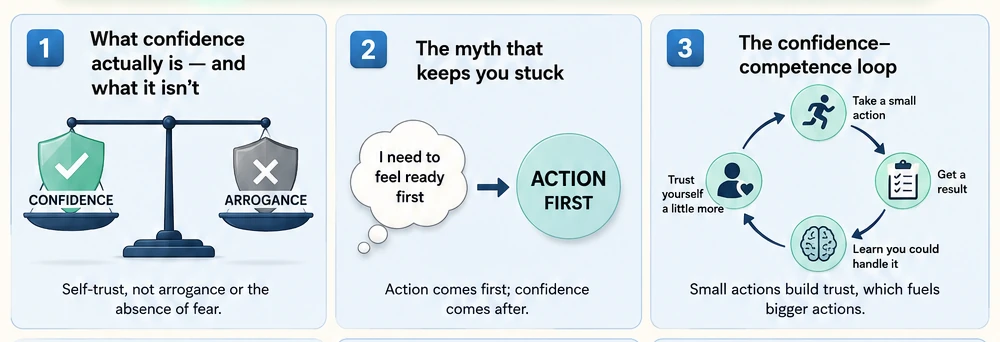
Stand like you mean it: body language first
Your body talks before you do — and it talks to you, too. Stand tall, shoulders back, weight even on both feet. Hold comfortable eye contact, roughly the amount you'd keep with a friend. Slow down: rushed speech broadcasts nerves, while a half-second pause signals you're at ease. You don't need to fake a booming voice; you just need to stop shrinking. Open, settled body language quietly calms you and reads as confidence to them — a rare two-for-one.
Prepare so you can be present
Most "confidence problems" are really uncertainty problems, and the cure for uncertainty is preparation. Before a job interview, rehearse your stories out loud until they're smooth. Before a hard conversation, get clear on your one main point. Before walking into a room of strangers, have two or three openers ready to go. Preparation shrinks the unknown, and a smaller unknown means a calmer you. The aim isn't to script every word — it's to free your attention so you can actually be there instead of panicking about what to say next.
Get out of your own head
Self-consciousness is simply attention pointed the wrong way — at yourself. The fastest fix is to aim it outward. Get genuinely curious about the other person: their answer to your question, the reason behind their opinion, the thing they obviously care about. Curiosity and anxiety struggle to share the same mind. This is the real secret behind people who seem effortless at small talk — they aren't performing, they're interested. When you're meeting new people, make your goal "learn one true thing about them," not "seem impressive."
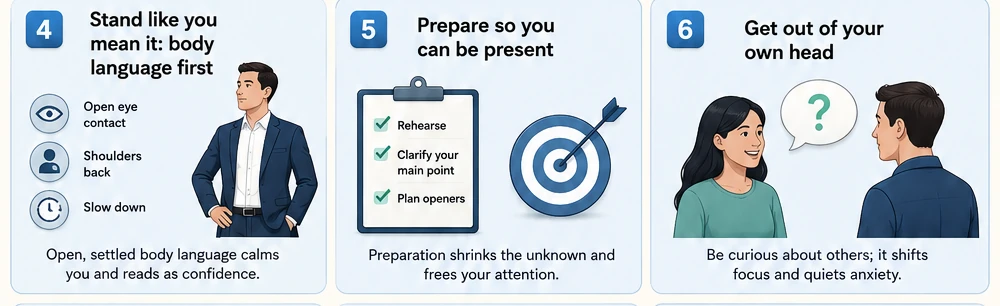
Talk to yourself like a coach, not a critic
Your inner voice runs commentary all day, and for most of us it's harsher than we'd ever be to a friend. You can't delete it, but you can re-train it. Catch the critic ("you're going to embarrass yourself") and answer it like a coach would ("you've handled worse — just be warm and ask questions"). Try swapping "I'm so nervous" for "I'm excited" — the body signals are nearly identical, but the second story serves you. Over a few weeks, the coaching voice gets louder and the critic quieter.
Lower the stakes with small, deliberate reps
You don't build confidence by white-knuckling through one terrifying event. You build it with a ladder of small, survivable reps. Say good morning to a stranger. Ask the barista one extra question. Voice the small opinion in a meeting. Send the first message instead of waiting to be messaged. Each rung is low-stakes enough that you'll actually do it, and each one feeds the loop. Stack enough small wins and the "big" moments slowly stop feeling so big.
Practise the moments that matter most
Confidence is context-specific. Being relaxed with old friends does not automatically transfer to a high-pressure job interview, a nervous first date, breaking the ice while meeting new people at an event, or turning an online dating match into a real plan. Each of these has its own rhythm and its own particular fears. The only way to get smooth is to rehearse the real thing — ideally somewhere the cost of fumbling is zero. It's the same principle behind every guide to building communication skills: reps beat theory. (Heading into interviews soon? Pair this with our job interview preparation tips.)
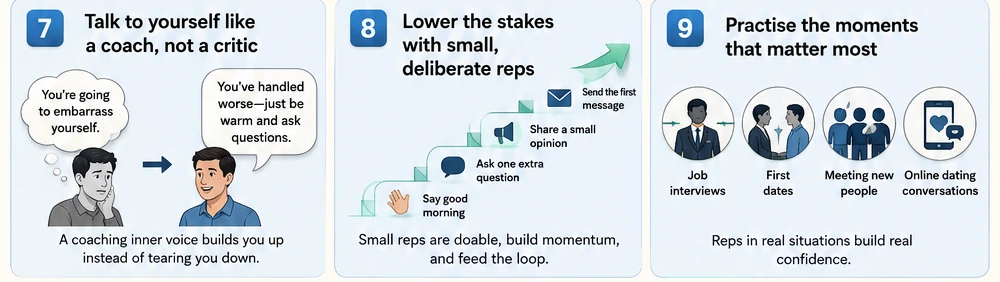
Bounce back: confidence is also how you handle the misses
Confident people are not people who never fail — they're people who refuse to treat a single stumble as a verdict. The awkward silence, the rejected pitch, the date that fizzles: these are data, not damnation. Name it, take the one lesson worth taking, and get back in sooner rather than later. The faster you take the next rep, the less power any single miss holds over you. Resilience and confidence turn out to be the same muscle seen from two different angles.
Build a track record — small wins compound
Confidence is, in the end, evidence. The more proof you collect that you can do hard social things and survive, the more your baseline shifts from "I hope I don't mess this up" to "I've got this." So keep the evidence visible: notice the wins, however small, instead of only logging the misses. Tracking your progress — a streak, a level, a number that climbs — turns invisible growth into something you can actually see, which is exactly why it sticks.
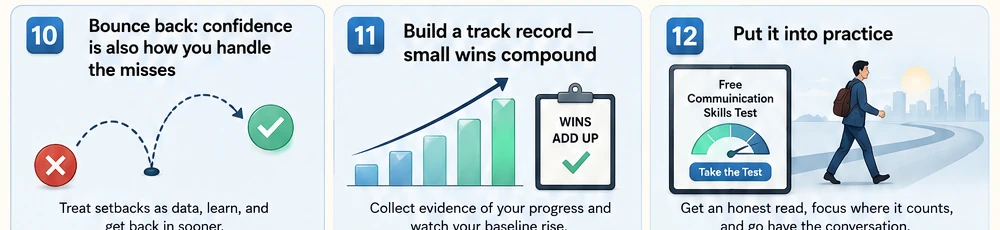
None of this requires a personality transplant. It requires reps — the slightly-awkward conversation, the braver question, the message sent instead of agonised over. Confidence and strong communication skills grow together, one real conversation at a time. Want an honest read on where your conversation confidence stands right now? Take our free communication skills test — it scores six dimensions of real conversation and shows you exactly where to focus first. Then go put it into practice.
Confidence isn't a feeling you wait for. It's reps you put in.
Step into realistic conversations — interviews, dates, small talk and online chats — make your choices, and watch your nerve grow one round at a time.
Start building confidence now