
How to Build Communication Skills: A Step-by-Step Guide
Published June 24, 2026 · 12 min read
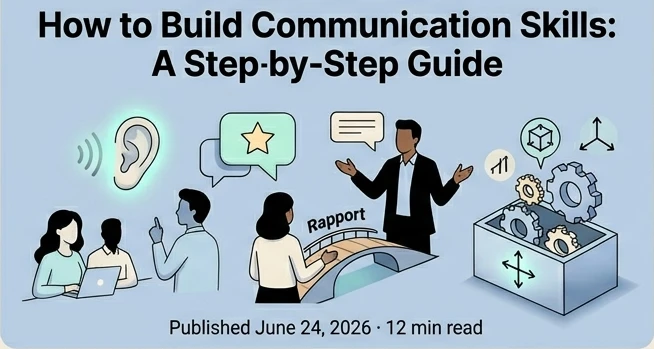
Almost everything good in life moves through a conversation — the job you want, the friendships you keep, the relationship you're hoping for, the raise you're too nervous to ask for. That's why learning how to build communication skills is one of the highest-return things you can do with your time. And the best news is this: communication is a skill, not a fixed personality trait. Nobody is born knowing how to handle a tense disagreement or how to make a stranger feel instantly at ease. Those abilities are built, rep by rep, the same way you'd build strength at the gym.
This guide walks you through exactly how to develop communication skills from the ground up: what they actually are, why they matter, and a clear, step-by-step plan — finished off with a simple 30-day routine that turns the theory into habits you'll keep for life.
What do we mean by "communication skills"?
"Communication skills" sounds like one thing, but it's really a stack of related abilities working together. When you build communication skills, you're actually strengthening six core dimensions:
- Active listening — fully focusing on the other person so they feel understood, instead of waiting for your turn to talk.
- Clarity — saying what you mean in a way that's easy to follow, without rambling or burying the point.
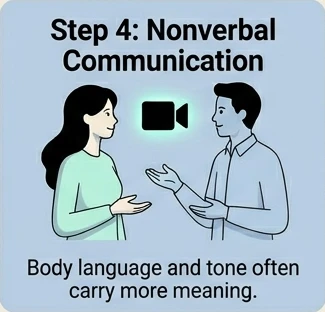
- Nonverbal communication — body language, eye contact, tone of voice and facial expression, which often carry more meaning than the words.
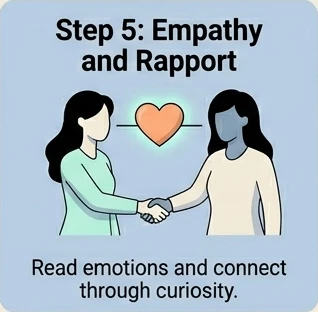
- Empathy and rapport — reading emotions and building a sense of connection and trust.
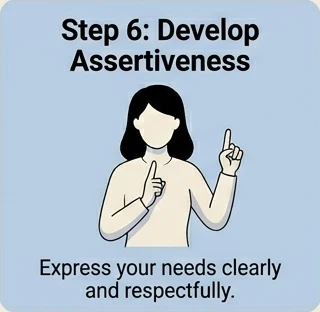
- Assertiveness — expressing your needs, opinions and boundaries clearly and respectfully.
- Adaptability — adjusting how you communicate to the person, the context and the moment.
Strong communicators aren't elite in all six at once. They're simply solid across the board and know which one a given moment calls for. That's the goal of this guide.
Why building communication skills matters
Before the how, a quick word on the why — because motivation is what keeps you practising past week one. Effective communication is consistently ranked by employers as one of the most valuable soft skills in the workplace, and it's the single biggest predictor of how a job interview goes. Outside of work, the quality of your relationships, your dating life and your friendships all rise and fall on how well you connect and express yourself. People who communicate well are perceived as more competent, more likeable and more trustworthy — even when their raw expertise is identical to someone who can't get their point across.
In short: building communication skills doesn't just help you talk better. It quietly upgrades almost every area of your life.
Step 1: Diagnose your starting point
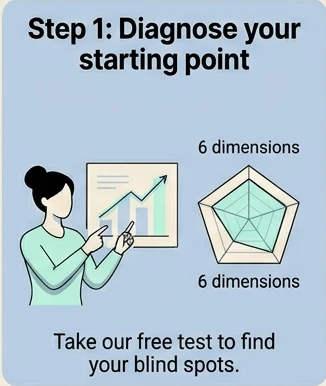
You can't improve what you haven't measured. Before you build anything, get an honest read on where you stand across those six dimensions. Most people are strong in one or two and quietly weak in the rest — maybe you're a great listener but freeze up when you need to be assertive, or you're clear and confident but talk over people without realising it.
The fastest way to find your blind spots is to take our free communication skills test. It scores six dimensions of real conversation and tells you, bluntly, which one to work on first — so you spend your energy where it actually counts instead of guessing.
Step 2: Build the foundation — active listening
If you only build one skill, build this one. Most people listen just enough to find a gap where they can insert their own opinion. Genuine listeners do something different: while the other person speaks, their only job is to understand — not to prepare a reply.
Three habits make active listening real:
- Don't interrupt. Let people finish, then pause for a beat before responding. The silence feels long to you and reassuring to them.
- Reflect back. Briefly summarise what you heard — "so the frustrating part was the waiting?" It costs five seconds and instantly makes people feel heard.
- Ask a follow-up. A good follow-up question proves you were actually listening and keeps the conversation flowing naturally.
This one habit improves every conversation you'll ever have, from a high-stakes job interview to a nervous first date.
Step 3: Sharpen your clarity
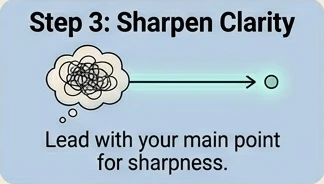
Clarity is kindness. When you bury your main point under three minutes of background, people quietly check out. The fix is to lead with your point, then add detail only if it's wanted. In a message, put the ask in the first line. In a story, get to the tension fast. In a meeting, state your conclusion before your reasoning.
A practical drill: before you speak in any important moment, silently finish the sentence "The one thing I want them to take away is…" Then say that first. People will think you're sharper — because being easy to follow is a form of sharpness.
Step 4: Master nonverbal communication
Researchers estimate that a large share of the meaning we receive comes not from words but from tone of voice and body language. You can say "I'm happy to help" and have it land as warm or icy depending entirely on how you deliver it. To build this layer:
- Eye contact: hold it warmly without staring — roughly while you listen, with natural breaks while you speak.
- Open posture: uncross your arms, face the person, relax your shoulders. Closed posture reads as defensive even when you don't feel that way.
- Tone and pace: slow down. Nervousness speeds us up; calm authority comes from leaving space between sentences.
- Match your face to your message: a genuine smile, a thoughtful nod, a concerned brow — these signal that you're present and engaged.
Record yourself on video once — a mock answer to an interview question works well — and watch it on mute. You'll learn more about your nonverbal communication in two minutes than in any article.
Step 5: Build empathy and rapport
Rapport is the feeling that two people are "in sync." You build it by reading the other person's emotional state and meeting them there before trying to shift it. If they're tense, slow down and lower your voice. If they're playful, lighten up. Notice and name feelings ("that sounds exhausting") and find genuine common ground.
The simplest rapport engine of all is curiosity: the fastest way to be interesting is to be interested. Swap closed yes/no questions for open ones — not "Good weekend?" but "What was the best part of your weekend?" This is the heart of small talk and the difference between awkward and easy when you're meeting new people.
Step 6: Develop assertiveness and handle hard conversations
Many people who are warm and likeable still struggle to state what they want or hold a boundary. Assertiveness is the bridge between being a pushover and being aggressive — it's expressing your needs clearly while respecting the other person's.
A reliable formula for difficult moments is to acknowledge, then state, then ask: "I can see you're under pressure on this (acknowledge). I'm not able to take on the extra work this week (state). Can we look at the deadline together (ask)?" When tension rises, resist the urge to win. Disagreement isn't the enemy of communication — contempt is. People remember how you made them feel in a hard moment far longer than who was technically right.
Step 7: Practise in the situations that actually matter
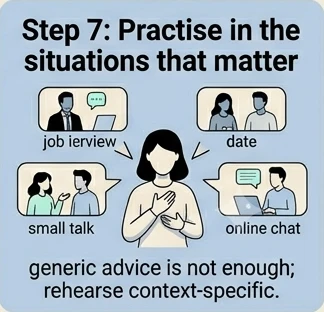
Here's the catch that trips most people up: communication skills are context-specific. The version of you who's relaxed and funny with close friends is not automatically the version of you in a high-pressure job interview, on a nervous first date, breaking the ice while meeting people at an event, or trying to carry an online dating chat from a match to a real plan. Each context has its own rhythm, stakes and unwritten rules.
That's why generic advice only takes you so far. To get genuinely smooth, you have to rehearse the specific situations you care about — ideally in a low-stakes setting where a clumsy reply costs you nothing and teaches you everything.
Step 8: Get reps, not just theory
This is the most important step, and the one almost everyone skips. Reading an article like this one feels like progress, but nothing actually changes until you do the reps. Skills come from repetition under realistic conditions: having the slightly-awkward conversation, asking the braver question, sitting with a silence instead of rushing to fill it.
Interactive roleplay is the most efficient way to get those reps safely. On Talkingskill.com you step into real, branching conversations — interviews, dates, small talk and online chats — choose your replies, and watch exactly how each one lands. You build the muscle memory without the real-world risk, and the awkwardness fades far faster than you'd expect.
Your 30-day plan to build communication skills
Here's how to turn all of this into a routine. Twenty focused minutes a day is plenty:
- Week 1 — Listen. In every conversation, reflect back what you heard before you respond. Take the communication skills test to find your weakest dimension.
- Week 2 — Clarity & nonverbals. Lead with your point. Record one short mock answer and review it on mute to check your body language.
- Week 3 — Rapport. Ask one open-ended question to a new person every day. Practise matching energy before shifting it.
- Week 4 — Pressure-test it. Rehearse your real high-stakes scenarios — the interview, the date, the networking event — through interactive roleplay until they feel routine.
Do this for a month and the change won't feel like a performance — it'll feel like you, just clearer, warmer and more confident.
Common mistakes when building communication skills
- Treating it as theory. Watching videos and reading guides without practising is the number-one reason people stay stuck.
- Trying to fix everything at once. Pick one dimension at a time. Layering beats overhauling.
- Mimicking a "confident" persona. Borrowed scripts feel fake. Build on your real personality instead.
- Avoiding discomfort. The slightly-awkward conversation is the rep. Skipping it skips the growth.
Frequently asked questions
How long does it take to build communication skills?
Most people notice a real difference within three to four weeks of daily practice. Because communication is a skill rather than a personality trait, it responds to reps — about twenty focused minutes a day for a month is enough to make active listening, clearer answers and steadier body language start to feel natural.
Can you build communication skills if you're shy or introverted?
Absolutely. Shyness and introversion are about energy and comfort, not ability — introverts often make excellent communicators because they listen deeply and think before speaking. The key is low-stakes practice that lets the nerves fade gradually, rather than throwing yourself into overwhelming situations.
What should I build first?
Start with active listening and clarity. Listening makes people feel understood and hands you the information to respond well; clarity makes you easy to follow. Once those two are solid, layer on nonverbal communication, rapport and assertiveness.
Not sure which of the six skills is already strong and which is quietly holding you back? Take the free communication skills test and find out exactly where to start.
Reading won't build the skill. Reps will.
Step into real, interactive conversations — interviews, dates, small talk and online chats — choose your replies, and watch how each one lands.
Start practising now