How to Be a Better Listener: 7 Active Listening Skills That Change Every Conversation
Published June 26, 2026 · 8 min read · Updated July 5, 2026

Talkingskill.com administration
The team behind the conversation scenarios and the six-skill communication test.

Ask anyone what makes a great communicator and they'll usually describe a talker — someone quick, funny, persuasive. But spend time with the people others trust most, and you'll notice the opposite: they're great listeners. Listening is the most underrated skill in communication, the one that quietly decides whether people open up to you or hold back. The good news is that it isn't a personality trait — it's a set of habits you can practise. Here are seven that turn ordinary listening into the kind that makes people feel genuinely heard.
1. Listen to understand, not to reply
Most of us don't really listen — we wait. While the other person talks, we're loading our response, hunting for the gap to jump in. Real listening means giving up that running commentary in your head and making one job your only job: understand what this person actually means. You'll know you're doing it when you stop being able to predict your next sentence. The reply can wait two seconds; the understanding can't be faked.

2. Let silence do some of the work
Silence feels awkward, so we rush to fill it — and in doing so we step on the most honest things people are about to say. The deepest answers often come right after a pause, once someone has finished the easy version and reached for the real one. Try counting two beats after they stop before you speak. That small gap signals you're not just waiting for your turn, and it gives the other person room to go further than they planned to.
3. Reflect back what you heard
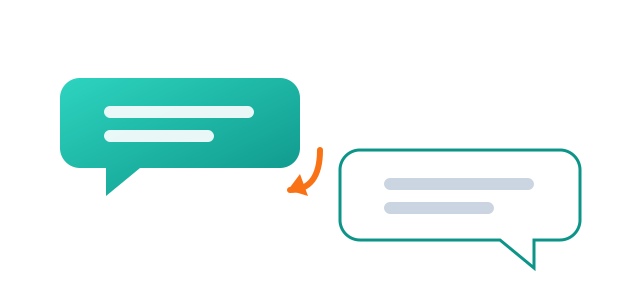
The single fastest way to make someone feel understood is to say their point back in your own words: "So the frustrating part wasn't the work — it was that nobody told you." It does two things at once. It proves you were actually listening, and it gives them a chance to correct you if you got it wrong. This one move — reflecting — is the backbone of every good conversation, from a tense disagreement to a quiet first date where someone is testing whether they can trust you.
4. Listen with your whole body
People decide whether you're listening long before they weigh your words. They read your eyes, your posture, whether your hand drifts toward your phone. Turn your body toward the speaker, hold relaxed eye contact, and let your face actually react — a nod, a wince, a small laugh. This isn't performance; it's feedback that tells the other person it's safe to keep going. Take the phone out of sight entirely. A screen face-down on the table still says "I'm half here."

5. Ask the follow-up, not the next topic
Weak listeners collect facts and move on: "Oh, you went to Spain? I went to Italy once." Strong listeners go deeper into what's already on the table: "What made you pick Spain?" The follow-up question is the clearest proof that you were listening, and it's the engine of real conversation. It's what separates awkward from easy when you're meeting new people, and it's what turns a flat exchange of bios into something that feels like a connection.
6. Hold back your fixes and your judgments
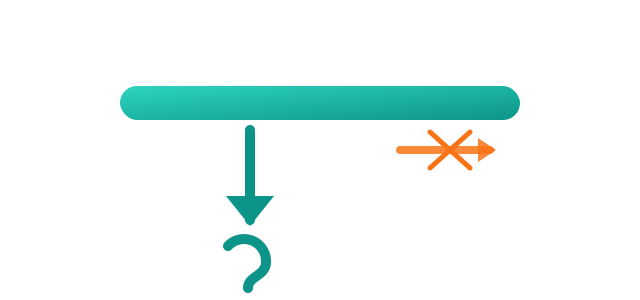
When someone shares a problem, the urge to solve it — or to quietly judge it — is almost automatic. But most of the time people aren't asking to be fixed; they're asking to be heard first. Jumping to advice tells them the conversation is now about you and your cleverness. Try asking, "Do you want me to help think it through, or do you just need to vent?" That one question respects them, and it makes the advice you do give land far harder when it's actually wanted.
7. Practise listening where it's hard
Listening is easy when you're calm and the stakes are low. It collapses exactly when it matters most — in a high-pressure job interview where nerves make you talk over the question, in a conflict where you're itching to defend yourself, or in an online dating chat where it's tempting to wait for your turn to be impressive. These are the moments worth rehearsing, because the version of you who listens well under pressure is built through reps, not good intentions.

Curious how your listening stacks up against the rest of your conversation skills? Take our free communication skills test — it scores six dimensions of real conversation and shows you, bluntly, where listening is helping you and where it's letting you down.
Related reading
You can't learn to listen by reading about it.
Step into real, interactive conversations — interviews, dates, small talk and online chats — and practise hearing people out before you reply.
Start practising now