How to Build Rapport: 7 Ways to Make People Feel Instantly at Ease With You
Published June 29, 2026 · 8 min read · Updated July 5, 2026

Talkingskill.com administration
The team behind the conversation scenarios and the six-skill communication test.

You've felt it: that conversation where everything just flows. You finish each other's thoughts, the jokes land, and ten minutes in it feels like you've known the person for years. That feeling has a name — rapport, the quiet sense that two people are on the same wavelength. It's what turns a stranger into someone you trust, and it's the difference between a stiff exchange and a real connection. The best part: rapport isn't luck or chemistry you either have or don't. It's a set of moves you can learn and repeat on purpose. Here are seven that build it fast.
1. Lead with warmth, not impressiveness
When we want someone to like us, the instinct is to prove we're smart, funny, or successful. But people don't warm to the most impressive person in the room — they warm to the one who makes them feel good. Before you try to be interesting, try to be interested and kind: a genuine smile, an open posture, a tone that says "I'm glad you're here." Warmth lands first and fast, and it gives everything you say afterward the benefit of the doubt. Save the impressive stuff for later — or skip it entirely.

2. Find the thread you have in common
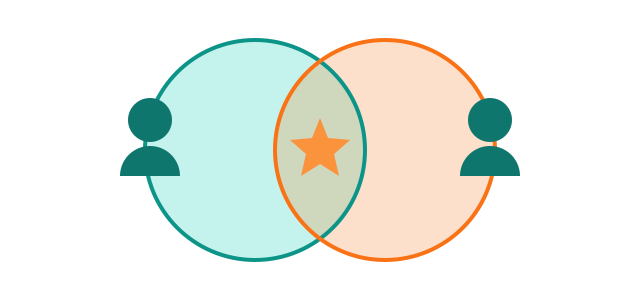
Rapport accelerates the moment two people discover something shared — a hometown, a frustration, a favorite show, a way of seeing the world. So go looking for it. Ask the kind of light, open questions that surface common ground, and when you hear a thread, pull on it: "Wait, you grew up there too?" This is the engine of good small talk — it's not about the weather, it's about scanning for the overlap. Even a tiny match ("you're a morning person too?") creates an instant sense of us, and that's what rapport is built from.
3. Match their energy and pace
We feel comfortable with people who feel like us. If someone is calm and measured, meeting them with frantic energy makes them tense; if they're bright and fast, answering in slow monotone makes it fall flat. Subtly tune your volume, pace, and energy toward theirs — not mimicry, just landing in the same key. This is why a quiet first date goes better when you match the other person's softer rhythm instead of performing over it, and why the easiest conversations feel like two people breathing in time.
4. Use their name and remember the details
Nothing says "you matter to me" like remembering. Use someone's name early in a conversation, and circle back to the small things they mention — the trip they're nervous about, the dog with the funny name. Bringing a detail back later ("So how did the move go?") is one of the most powerful rapport moves there is, because it proves you were actually paying attention. It works everywhere, from meeting new people at a party to a follow-up in a job interview, where naming something specific the interviewer said makes you instantly more memorable.

5. Show you're listening — visibly
Rapport is a two-way signal, and people read your reactions more than your words. Nod, react, let your face move, and ask the follow-up question instead of jumping to your own story. The single fastest way to deepen a connection is to reflect back what you heard — "so the hard part wasn't the work, it was that nobody noticed." It tells the other person they've been understood, not just heard. (We go deep on this in our guide to becoming a better listener.)

6. Be a little open first
Trust is reciprocal: people tend to open up to the degree that you do. If every answer you give is guarded and surface-level, the other person stays guarded too. Sharing something a touch personal — a real opinion, a small admission, a genuine reaction — gives them permission to do the same, and rapport deepens in that back-and-forth. This matters especially in online dating, where it's tempting to keep things polished and safe; a single honest, slightly vulnerable message often does more than a dozen clever ones. The key is matching the depth to the moment, not over-sharing.
7. Practise where the stakes are real
Rapport is easy to understand and surprisingly hard to do when it counts — when you're nervous, when you want the outcome too much, when one good impression really matters. That's exactly when the warmth tightens up and the curiosity disappears. The fix isn't more theory; it's reps. Rehearse these moves in low-stakes conversations until they're automatic, so that in the high-pressure ones — the interview, the date, the first meeting with someone you really want to like you — they're already part of how you show up.

Want to know how good you already are at building rapport? Take our free communication skills test — it scores six dimensions of real conversation and shows you, honestly, where you connect with people and where you lose them.
Related reading
You can't build rapport by reading about it.
Step into real, interactive conversations — interviews, dates, small talk and online chats — and practise making people feel at ease, one reply at a time.
Start practising now